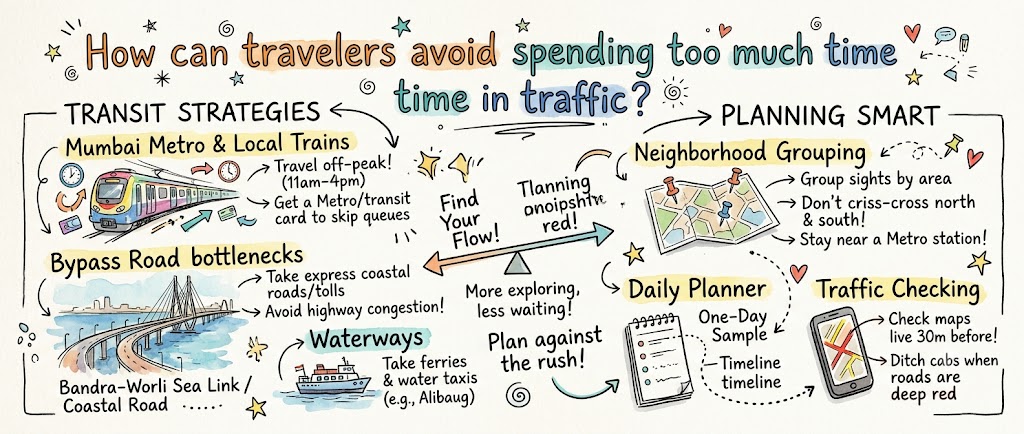
Mumbai is an exciting city filled with historic landmarks, coastal views, and lively markets. However, heavy road congestion can quickly eat into your holiday hours. Travelers can avoid spending too much time in traffic by traveling outside peak rush hours. You can also group attractions by neighborhood and use the expanding Mumbai Metro and suburban rail networks.
Understanding how the city moves makes your trip much smoother. Instead of sitting in slow cabs, you can spend more time exploring museums, beaches, and cafes. This guide shares practical transport choices, timing tips, and route plans to help you save hours on the road.
Understanding Mumbai Traffic Patterns
Mumbai is built on a long, narrow peninsula. Millions of commuters travel south toward business districts in the morning. Those same workers travel north back to the suburbs in the evening.
This geography creates predictable traffic bottlenecks during office rush hours. Road construction, narrow heritage lanes, and monsoon rains can also slow vehicles down. When you know these daily patterns, you can plan your rides against the main crowd flow.
Morning and Evening Rush Hours
Morning rush hour runs from 8:00 AM to 11:00 AM on weekdays. During this window, roads heading south toward Dadar, Lower Parel, Bandra-Kurla Complex, and Fort are very busy. Evening rush hour starts around 5:30 PM and lasts until 9:00 PM as traffic moves north.
Traveling against the rush is a smart trick for visitors. If you stay in South Mumbai, travel north only during mid-day hours. If you stay in the suburbs, visit southern landmarks after 11:00 AM.
Seasonal and Festival Road Delays
The monsoon season from June to September brings heavy rain that can cause waterlogging in low-lying areas. Potholes and poor visibility also reduce vehicle speeds across the city. Major festivals like Ganeshotsav in late summer draw huge street processions.
During festival days, police close several main roads and redirect buses and cabs. Always check local traffic advisories before stepping out during holidays or heavy rain.
Best Transport Options to Beat Road Congestion
Relying only on road taxis is the fastest way to lose time in Mumbai. Combining trains, metro lines, and express coastal roads keeps your day moving on schedule. Readers can browse community discussions on Mumbai trains and transport
to see how locals combine these modes every day.
Mumbai Metro Network
The Mumbai Metro is one of the best ways for tourists to skip road traffic completely. The underground Aqua Line 3 connects Cuffe Parade in the south to Aarey Colony in the north. It stops near major hubs like Churchgate, CSMT, Dadar, Worli, BKC, and both airport terminals.
Elevated lines like Line 1 between Versova and Ghatkopar and Lines 2A and 7 in the western suburbs are also very helpful. Trains are air-conditioned, clean, and run on fixed schedules unaffected by street jams. You can explore more commuter tips in the Metro and Monorail forum
before planning your transfers.
- Best Experience: Riding in cool comfort straight from South Mumbai to the airport or northern suburbs.
- Key Features: Air-conditioned coaches, digital ticketing, lift access, and fast travel times.
- Pros: Zero road traffic delays, affordable fares, and safe for families and solo travelers.
- Cons: Stations can get busy during office hours, and last-mile cab rides may still be needed.
- Who Should Choose It: Almost all travelers, especially those heading to the airport or crossing between north and south zones.
- Who Should Skip It: Visitors carrying oversized luggage that exceeds metro security scanner limits.
- Practical Tip: If you have an early flight, check how to reach Mumbai airport using Metro Line 3 to avoid unpredictable highway jams.
- Recommendation: Use the metro as your primary cross-city link whenever a station is nearby.
Suburban Local Trains and AC Locals
Mumbai’s suburban railway is the lifeline of the city. The Western, Central, and Harbour lines connect almost every neighborhood. Standard trains and air-conditioned (AC) local trains run throughout the day.
Trains cover long distances across the city in a fraction of the time a taxi takes. You can book tickets easily through the official Indian Railways UTS mobile system
to skip station ticket queues.
- Best Experience: Boarding a mid-day AC local train from Churchgate to Bandra for a fast, comfortable ride.
- Key Features: Frequent departures, dedicated ladies’ compartments, first-class coaches, and AC train services.
- Pros: Extremely fast over long distances and very low ticket prices.
- Cons: Extreme crowding during peak office hours makes boarding difficult for beginners.
- Who Should Choose It: Solo travelers, couples, and budget visitors traveling between 11:30 AM and 4:00 PM.
- Who Should Skip It: Travelers with young children, frail seniors, or heavy suitcases during peak hours.
- Practical Tip: Only board local trains during off-peak mid-day hours and pay extra for First Class or AC coaches.
- Recommendation: Great for fast north-south leaps when you travel outside rush hours.
High-Speed Road Links and Coastal Routes
When you must take a cab, choosing the right highway saves huge amounts of time. The Brihanmumbai Municipal Corporation (BMC)
built the Mumbai Coastal Road to connect Marine Lines directly to the Bandra-Worli Sea Link. On the eastern side, the Eastern Freeway and Atal Setu speed up travel toward Navi Mumbai.
These toll roads and undersea tunnels bypass dozens of crowded city traffic signals. While feeder roads can still slow down near exit ramps, the main stretches move quickly.
- Best Experience: Gliding from Marine Drive to Bandra along the Arabian Sea coast in under 20 minutes.
- Key Features: Multi-lane expressways, undersea tunnels at Malabar Hill, and scenic sea views.
- Pros: Door-to-door comfort in a private cab while bypassing inner-city intersections.
- Cons: Sea Link tolls add to your cab fare, and exit bottlenecks still happen at peak times.
- Who Should Choose It: Families, seniors, and business travelers who prefer private car comfort.
- Who Should Skip It: Strict budget travelers who want to avoid cab fares and bridge tolls.
- Practical Tip: Ask your cab driver to take the Coastal Road or Sea Link instead of regular city streets.
- Recommendation: Worth every rupee when traveling by car between South Mumbai and Bandra.
Ferries and Water Taxis
Mumbai’s eastern harbor offers water routes that skip roads altogether. Ferries and speedboats run from the Gateway of India and Ferry Wharf (Bhaucha Dhakka) to Mandwa (Alibaug) and Elephanta Island. Roll-on/roll-off (Ro-Ro) vessels also carry passengers and vehicles across the harbor.
Water travel turns a long, bumpy highway drive around the creek into a breezy sea ride. Services depend on weather conditions, and some boats pause during the rough monsoon months.
- Best Experience: Taking a morning Ro-Ro ferry or catamaran from South Mumbai to Mandwa Jetty for a coastal getaway.
- Key Features: Open decks, air-conditioned lounges on larger vessels, and zero road signals.
- Pros: Saves two to three hours compared to driving around the harbor by road.
- Cons: Limited to coastal destinations and subject to monsoon weather cancellations.
- Who Should Choose It: Weekend travelers heading to Alibaug, Navi Mumbai coast, or Elephanta Caves.
- Who Should Skip It: Travelers prone to seasickness during choppy weather.
- Practical Tip: Book Ro-Ro or speed boat tickets online in advance during weekends.
- Recommendation: Always choose water transport over road travel when visiting Alibaug or Elephanta.
Comparison of Mumbai Transport Options for Avoiding Traffic
| Transport Mode | Traffic Resistance | Best Travel Hours | Comfort Level | Ideal Route Type |
| Mumbai Metro (Line 1, 2A, 3, 7) | Very High (Grade-separated) | 6:30 AM – 10:30 PM (Best off-peak) | High (Air-conditioned) | Cross-city and Airport transfers |
| Suburban Local Trains (AC / First Class) | Very High (Dedicated tracks) | 11:30 AM – 4:00 PM & after 9:00 PM | Moderate to High (in AC coaches) | Long north-south suburban hops |
| Cabs via Coastal Road & Sea Link | Moderate to High | 11:00 AM – 5:00 PM | High (Door-to-door private ride) | Marine Drive to Worli and Bandra |
| Black-and-Yellow Taxis & Autos | Low (Stuck in street traffic) | Before 8:00 AM or after 9:30 PM | Low to Moderate | Short neighborhood hops under 3 km |
| Harbor Ferries & Ro-Ro Boats | Very High (Open water route) | Morning and Afternoon slots | High | Gateway/Mazgaon to Elephanta or Alibaug |
Smart Route and Neighborhood Planning
Even the fastest train cannot save your schedule if you zigzag across the city all day. Grouping your sightseeing stops by area is the secret to a relaxed holiday.
Group Sightseeing by Zone
Divide Mumbai into clear zones and explore only one or two adjacent zones per day. Keep South Mumbai (Colaba, Fort, Kala Ghoda, Marine Drive) for one full day. Save Bandra, Worli, and Juhu for a separate day.
Inside historic neighborhoods, walking is often faster than taking a cab. You can check local discussions on South Mumbai and Town
to find the best walking routes between heritage buildings, galleries, and cafes.
Choose the Right Hotel Location
Where you sleep determines how much traffic you face every morning. If your main goal is visiting museums, heritage monuments, and art galleries, stay in Fort, Colaba, or Marine Drive. If you are visiting for business meetings or concerts in the suburbs, stay near BKC or Andheri.
Picking a hotel within walking distance of a Metro Line 3 or suburban rail station gives you an immediate escape from street jams. You can step onto a train and reach another zone in minutes.
Recommendations for Different Types of Travelers
Every traveler has different comfort needs and energy levels. Pick the traffic strategy that matches your group best.
- Families with Children: Combine morning sightseeing by cab on the Coastal Road with mid-day breaks at your hotel. Use Metro Line 3 during non-peak hours instead of crowded local trains.
- Senior Travelers and Mobility-Conscious Visitors: Avoid peak hours completely and stick to door-to-door cabs between 11:00 AM and 4:00 PM. When planning coastal outings, check tips around Marine Drive sightseeing for accessible paths and calm morning hours.
- Solo Travelers and Backpackers: Use the Metro and First-Class local trains during mid-day hours. Walk between close landmarks in Fort and Bandra to soak in street life without waiting in cab lines.
- Business Travelers: Book hotels in the exact district of your meetings, such as BKC or Lower Parel. Use Metro Line 3 for airport runs so you never risk missing a flight due to highway congestion.
- First-Time Visitors: Plan no more than three major stops per day. Cluster all morning stops in one neighborhood and use an afternoon metro ride if you want to see a second area.
Practical Step-by-Step Planning Guide
Follow these simple steps before and during your trip to keep road delays to a minimum:
- Pin Your Places on a Map: Mark all the attractions and restaurants you want to visit on a digital map before your trip.
- Cluster Pins by Neighborhood: Group nearby pins together so you never cross the Bandra-Worli Sea Link more than once a day.
- Check Live Traffic Before Booking a Cab: Look at real-time traffic maps 30 minutes before leaving. If the road line is dark red, switch to the nearest Metro station.
- Buy a Single Transit Card: Check community advice on how to use one card across different Mumbai Metro lines via the National Common Mobility Card (NCMC) to save ticket time.
- Schedule Indoor Stops for Mid-Day: Visit air-conditioned museums, malls, or restaurants between 1:00 PM and 4:00 PM, then stroll outdoor promenades at sunset.
Sample 1-Day Low-Traffic Mumbai Itinerary
Illustrative Example: This sample plan shows how a visitor staying near Churchgate or Fort can see both South Mumbai and Bandra in one day with minimal road traffic.
- 8:30 AM – Morning Walk in Colaba: Take a 10-minute taxi ride south (against morning office traffic) to the Gateway of India. Walk to nearby heritage streets and enjoy breakfast at a local cafe before crowds arrive.
- 10:30 AM – Stroll to Kala Ghoda: Walk 12 minutes north to the Kala Ghoda art district and visit the Chhatrapati Shivaji Maharaj Vastu Sangrahalaya (museum). Zero cab time is needed.
- 1:30 PM – Lunch in Fort: Walk 8 minutes to a traditional restaurant in Fort for lunch while outside roads are busy.
- 3:00 PM – Fast Transit North: Take a cab via the Mumbai Coastal Road and Bandra-Worli Sea Link during the quiet afternoon window, OR board the underground Metro Line 3 from Hutatma Chowk/Churchgate north toward Bandra.
- 4:30 PM – Bandra Heritage Walk: Explore Mount Mary Church, Chapel Road street art, and Bandstand Promenade on foot before evening highway congestion builds up.
- 7:30 PM – Dinner in Bandra: Instead of sitting in peak evening rush hour traffic at 7:00 PM, relax over a long dinner in Bandra.
- 9:30 PM – Smooth Return Ride: Take Metro Line 3 or the Coastal Road back to South Mumbai after evening office rush hour has cleared.
Common Mistakes Travelers Make in Mumbai Traffic
Avoiding a few common tourist habits can save you two or more hours every single day.
- Mistake 1: Booking Airport Cabs During Evening Rush Without Buffer Time. The Western Express Highway near the airport gets heavily jammed between 5:30 PM and 8:30 PM.
- Fix: Take Metro Line 3 directly to Terminal 1 or Terminal 2, or leave at least 3.5 hours before domestic flights during evening peak hours.
- Mistake 2: Taking Cabs for Very Short Distances in Busy Markets. Hailing a taxi for a 1-kilometer trip near Crawford Market or Dadar often takes longer than walking due to one-way streets and crowds.
- Fix: Walk distances under 1.5 kilometers in flat areas like Fort, Colaba, and Marine Drive.
- Mistake 3: Crossing Between North and South Mumbai Multiple Times a Day. Going from Juhu to Colaba in the morning, back to Bandra for lunch, and back to Marine Drive at sunset wastes four hours in cabs.
- Fix: Finish all activities in one zone before moving to the next region.
- Mistake 4: Boarding Local Trains at Dadar or Virar During Peak Hours. Trying to squeeze onto a suburban train at 9:00 AM or 6:30 PM is stressful and unsafe for visitors unfamiliar with the rush.
- Fix: Use local trains only between 11:30 AM and 4:00 PM, or take the air-conditioned Metro instead.
Frequently Asked Questions (FAQs)
1. What are the worst traffic hours in Mumbai?
Weekday mornings from 8:00 AM to 11:00 AM and evenings from 5:30 PM to 9:00 PM have the heaviest traffic. Saturday evenings also see busy road congestion near malls, beaches, and dining hubs.
2. Is the Mumbai Metro good for tourists?
Yes, the Mumbai Metro is clean, air-conditioned, and very reliable. Line 3 (Aqua Line) is especially useful for tourists because it connects South Mumbai landmarks, Dadar, BKC, and both airport terminals underground.
3. Does the Mumbai Coastal Road save time for tourists?
Yes, the Coastal Road connects Marine Lines in South Mumbai directly to Worli and the Bandra-Worli Sea Link. It bypasses busy city signals and cuts daytime cab travel between South Mumbai and Bandra down to 15–25 minutes.
4. Can tourists use auto-rickshaws everywhere in Mumbai?
No, auto-rickshaws are only allowed in the suburbs—from Bandra and Sion northward. They are not permitted in South Mumbai, where you must use black-and-yellow taxis, app-based cabs, buses, or trains.
5. What is the best day of the week to sightsee by car in Mumbai?
Sunday is the best day for road sightseeing. Office traffic is absent on Sunday mornings and afternoons, allowing you to cover places like South Mumbai, Worli, and Bandra quickly by cab.
6. How early should I leave for Mumbai Airport to avoid traffic delays?
If traveling by road during peak hours, add an extra 60 to 90 minutes to your normal travel time. Alternatively, board Metro Line 3 to reach Terminal 1 or Terminal 2 on a predictable schedule.
7. Are local trains safe for first-time visitors to Mumbai?
Yes, local trains are safe and efficient if you ride during off-peak hours (11:30 AM to 4:00 PM). Choose First Class or AC local coaches for more space, and women travelers can use the dedicated Ladies’ compartments.
8. Is walking practical for sightseeing in Mumbai?
Walking is very practical inside compact zones like Fort, Kala Ghoda, Colaba, and Marine Drive. However, Mumbai as a whole is huge, so you will need trains, metros, or cabs to move between different neighborhoods.
9. How does monsoon rain affect travel times in Mumbai?
Heavy monsoon rains between June and September often slow road traffic and can cause temporary waterlogging. During heavy downpours, elevated and underground metro lines are usually much more reliable than road cabs.
Conclusion
You do not have to lose your holiday hours sitting in bumper-to-bumper Mumbai traffic. By planning your outings between 11:00 AM and 5:00 PM, clustering your sightseeing stops by neighborhood, and using the underground Metro Line 3 and the Coastal Road, you can move across the city with ease. Start by mapping out your favorite attractions by zone today, and pair each day’s plan with the closest train or metro station for a smooth, stress-free Mumbai adventure