Introduction
Mumbai can offer very different trips to different people. A film fan may enjoy old cameras, while a food lover prefers a busy snack street.
Someone else may want sea views, art, shopping, or time among trees. So, the best plan starts with your interests.
To plan a Mumbai trip around your interests, choose two main themes first. Then, group suitable places by area, check access, and leave room for breaks.
You do not need to visit every famous landmark. A smaller route can give you more time for the experiences you enjoy.
Mumbai Orbit can help you discover events that fit your chosen themes.
1. Choose Two Main Interests Before Listing Places
First, write down what you enjoy doing on holiday. Think about activities rather than famous place names.
Your list might include food, films, buildings, art, nature, shopping, or live shows. Next, choose the two that matter most.
If you travel with others, ask each person for one main choice. Then, look for shared interests.
Also, record comfort needs before booking. These may include short walks, regular meals, easy seating, or limited steps.
For example, a heritage walk may suit someone who loves buildings. However, a focused museum visit may suit them better during heavy rain.
Use these preferences to shape the route from the start.
2. Match Your Interests with Suitable Experiences
Next, turn your themes into a short list of places. Choose experiences that offer something you want to learn, taste, or enjoy.
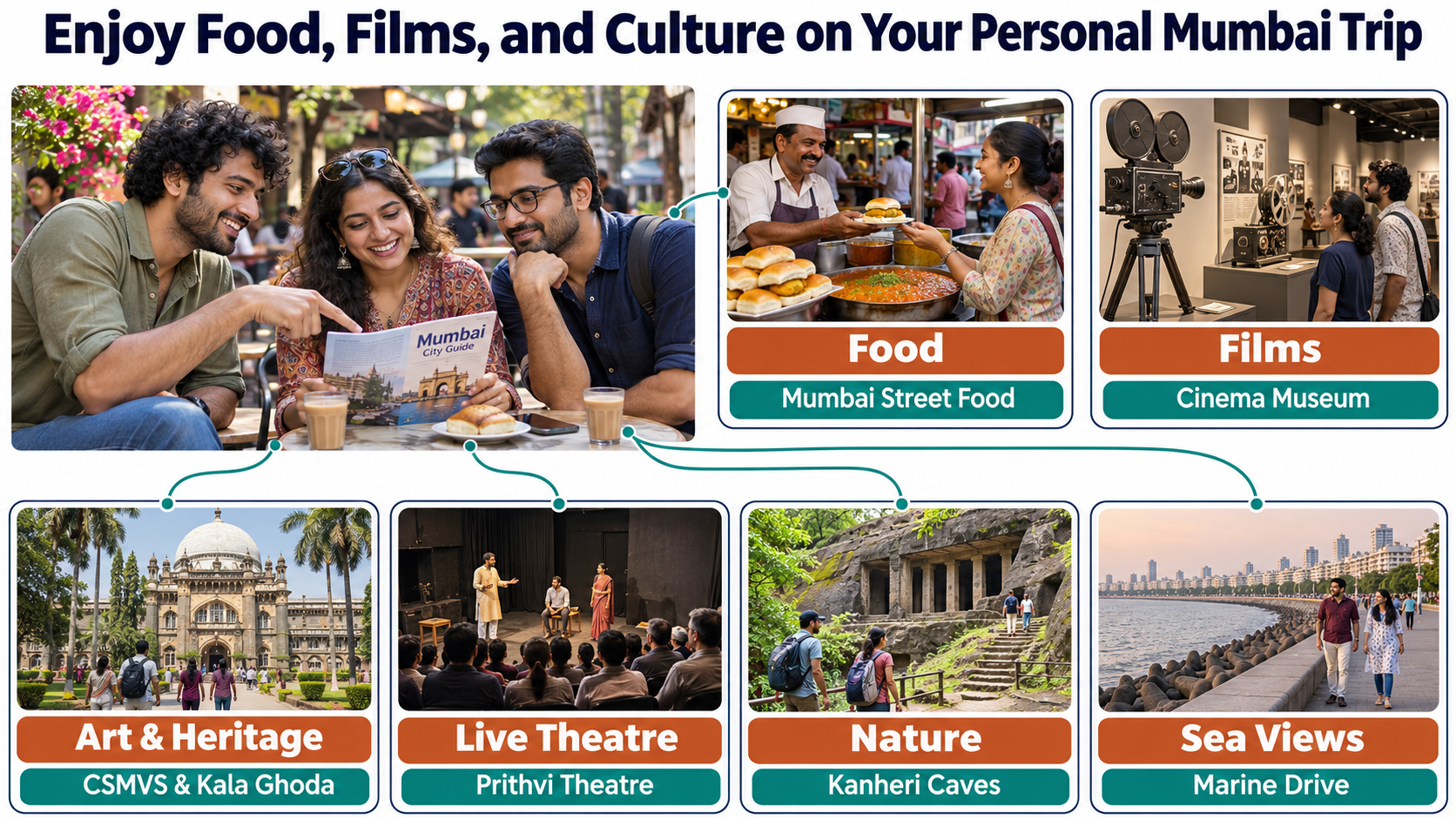
For history, consider Colaba’s streets and the buildings around Oval Maidan. For art, explore Chhatrapati Shivaji Maharaj Vastu Sangrahalaya, or CSMVS.
Film fans can consider the National Museum of Indian Cinema. A studio tour offers a different experience, so check its exact content.
For sea views, explore Marine Drive or Juhu Beach. Nature lovers can consider Sanjay Gandhi National Park and Kanheri Caves.
Also, choose food stops around your route. Avoid crossing the city for every dish on a long wish list.
3. Group Places by Area and Choose Your Base
A good hotel location should support your planned days. A cheaper room may lose value if every outing needs a long journey.
If most choices sit around Colaba, Fort, and Marine Drive, consider a base that serves South Mumbai well. For Juhu-focused plans, compare stays nearby.
Next, mark each chosen place on a map. Look at the full route, including meals and the return trip.
Do not treat all of Mumbai as one compact sightseeing area. For example, Kanheri and Colaba need separate planning.
Also, check the last part of each journey. A station near an attraction does not always mean an easy walk to its entrance.
4. Book the Right Experiences and Check the Full Cost
Book activities with fixed start times before adding flexible stops. These may include a play, guided walk, studio visit, or workshop.
First, confirm the organiser and exact venue. Then, check the language, length, age rules, and included services.
For a food tour, ask about ingredients, portions, and dietary needs. For a film tour, ask which areas visitors can enter.
Do not assume that a studio visit includes a celebrity meeting or live shoot.
Also, compare the total price. Tickets may leave out transport, meals, or attraction entry.
Mumbai Orbit can help you explore listed events. Read each offer carefully before paying.
5. Build Each Day Around One Main Experience
Give each half-day one main purpose. This keeps your interests at the centre of the trip.
For example, make a museum the main morning visit. Then, choose a nearby lunch and a short walk if time allows.
Next, leave a rest block between busy outings. A quiet meal can help more than another rushed stop.
For evening performances, protect the arrival time. Check the venue’s late-entry rules before planning a tight journey.
Also, keep an alternative for rain or changed access. A museum may replace an outdoor walk when suitable.
Finally, remove optional stops when the group feels tired. The plan should serve the travellers.
Real Experience & Personal Stories
Personal interests often lead to memorable small moments. A film fan may enjoy studying a camera more than taking another landmark photo.
During your trip, note one moment that held your attention. Then, explain what you learned or enjoyed.
Also, speak politely with guides, artists, and sellers when they have time. Ask before recording their words or sharing close photos.
Keep facts separate from feelings in your travel notes. Explain what you saw and what someone told you.
This article does not claim a personal visit. Instead, it helps you create an honest account of your own Mumbai experience.
Case Studies & Success Stories
These sample cases show how interests can change a route. They describe possible trips, rather than real customer results.
An art-loving couple chooses CSMVS and a short Kala Ghoda walk. They leave time to study a few works closely.
A film fan chooses the cinema museum. They compare it with a studio tour before deciding whether both suit their interests.
A family seeking fresh air chooses a park visit with manageable walking. They check access and avoid adding distant evening plans.
Each case defines success differently. One values detail, another values film knowledge, and another values comfort.
A shared checklist would not meet all three needs equally well.
Original Insights & Opinions
Plan around what holds your attention, rather than what looks best in someone else’s photos. This makes your choices easier to explain.
For example, loving films does not always mean enjoying a studio tour. You may prefer posters, equipment, or the history of sound.
Likewise, a food lover may enjoy one thoughtful meal more than many rushed tastings.
My recommendation is to give each main choice a clear purpose. Write one sentence about what you hope to enjoy there.
If you cannot explain the purpose, reconsider the stop.
Also, allow different people to enjoy the city differently. Separate short activities can sometimes suit a group better.
Industry Statistics & Research Data
Reliable venue details help you make better choices than broad popularity claims. Look for collection themes, visitor areas, and access notices.
For example, the National Museum of Indian Cinema occupies two buildings. Its displays explore film history through objects and digital material.
CSMVS lists collections covering subjects such as sculpture, textiles, paintings, and money. However, its visitor information also notes some gallery closures.
So, check that your chosen collection is accessible before making it the day’s main plan.
Do not judge the trip through visitor counts alone. A busy attraction may not match your interests, while a quieter gallery may suit you well.
Step-by-Step Guides & Tutorials
Follow this order to turn your interests into a workable trip.
Step 1: Count your usable time.
Record arrival, departure, work commitments, and fixed bookings.
Step 2: Choose two main themes.
Add one priority from each traveller where possible.
Step 3: Select a short list.
Choose a few experiences that clearly match those themes.
Step 4: Group nearby places.
Separate distant areas into different days.
Step 5: Check visitor details.
Confirm hours, closures, entry rules, and walking needs.
Step 6: Plan complete journeys.
Include queues, meals, local travel, and the return trip.
Step 7: Book fixed activities.
Save confirmations and read cancellation terms.
Step 8: Keep flexible extras.
Add them only when time, weather, and energy allow.
Expert Interviews & Quotes
A useful guide should help you explore your interests in depth. Ask them to explain how they would adapt the route.
For a heritage walk, request detail about building craft or local trade. For a museum visit, ask whether a focused tour is available.
Food hosts should explain ingredients and the planned tastings. Studio hosts should describe actual visitor access.
This article includes no private expert interview or invented quote. Instead, these questions support a useful conversation with a real provider.
Also, ask what happens if access changes. Clear answers help you compare offers before paying.
A confident promise matters less than a specific explanation.
Detailed Comparisons: Interests and Suitable Experiences
Use this table to narrow your choices. Treat each option as a starting point, rather than a fixed ranking.
| Your interest | Experience to explore | Detail to check |
|---|---|---|
| History and buildings | Colaba, Fort, Oval Maidan | Route, walking length, interior access |
| Art and objects | CSMVS | Relevant open galleries |
| Film history | National Museum of Indian Cinema | Hours and available displays |
| Live performance | A play at Prithvi Theatre | Language, age rules, start time |
| Food | A focused tasting walk or meal | Ingredients and included portions |
| Nature | Sanjay Gandhi National Park and Kanheri | Permitted activities and internal travel |
| Sea views | Marine Drive or Juhu | Weather and return journey |
Unique Frameworks & Methodologies
Use a simple Must, Match, Maybe method to sort your list. It prevents every interesting idea from becoming a firm commitment.
Must: Choose the experience you would most regret missing. Check access before building the day around it.
Match: Add a nearby activity that supports the same interest. A meal or short walk may fit well.
Maybe: Keep one optional extra for spare time. Avoid paying for it early unless availability requires booking.
Then, add travel and rest around those choices.
If the day becomes too full, remove the “maybe” first. This protects your main interests without making the whole trip feel rigid.
Real Examples & Use Cases
These sample day plans assume suitable access and enough travel time. Adjust them to your hotel and current conditions.
| Visitor type | Main plan | Lighter extra |
|---|---|---|
| Art and heritage lover | CSMVS visit | Short Kala Ghoda walk |
| Film enthusiast | National Museum of Indian Cinema | Meal and discussion afterwards |
| Sea-view seeker | Marine Drive outing | Nearby food stop |
| Theatre fan | Confirmed Prithvi Theatre performance | Juhu-area meal |
| Nature-focused traveller | Park or Kanheri visit | Rest near the same area |
Mumbai Orbit can help you find events that match these themes. However, verify the actual location.
A listing may name a venue outside your planned Mumbai area. Check the address before building travel around it.
Frequently Asked Questions About Mumbai Orbit
1. What is Mumbai Orbit?
Mumbai Orbit helps people discover listed events and book tickets for activities.
2. Can it help me find interest-based experiences?
Browse relevant listings, then compare the activity with your interests and available time.
3. Does Mumbai Orbit run every listed event?
Check the named organiser. Do not assume the platform runs each activity.
4. Does a ticket include the whole outing?
Read the offer. Transport, meals, guides, and attraction entry may cost extra.
5. Which interest should I choose first?
Start with the activity you most enjoy. Then, add a second theme for variety.
6. Should I visit famous places that do not interest me?
You can leave them out. Choose experiences that make the trip worthwhile for you.
7. Can families with different interests plan together?
Yes. Give each person a priority and balance busy activities with breaks.
8. Do studio tours guarantee celebrity meetings?
No. Confirm the actual visitor experience rather than relying on that expectation.
9. Can I combine distant Mumbai areas in one day?
Check the full travel plan first. Long journeys may leave little time for your main activity.
10. What should I confirm before paying?
Check the organiser, venue, timing, included services, full price, and refund terms.
Final Thought
Let your interests give the trip its shape. Mumbai offers enough variety for many different kinds of visits.
Choose a few meaningful experiences, group them sensibly, and protect time to enjoy them. Also, leave room for weather, delays, and changing energy.
Use Mumbai Orbit to explore events that fit naturally into your route.
A successful trip does not require every famous sight. It should give you time for the parts of Mumbai that matter to you.
Focus keyword: Mumbai trip around your interests
Target audience: First-time visitors, families, couples, and travellers seeking a personal Mumbai itinerary
SEO title / Meta title: Plan a Mumbai Trip Around Your Interests: Food, Films and Art
Meta description: Plan a Mumbai trip around your interests with clear steps, area-based routes, art and film ideas, food outings, nature visits, and booking tips.